ICDA Summer Conference 2026

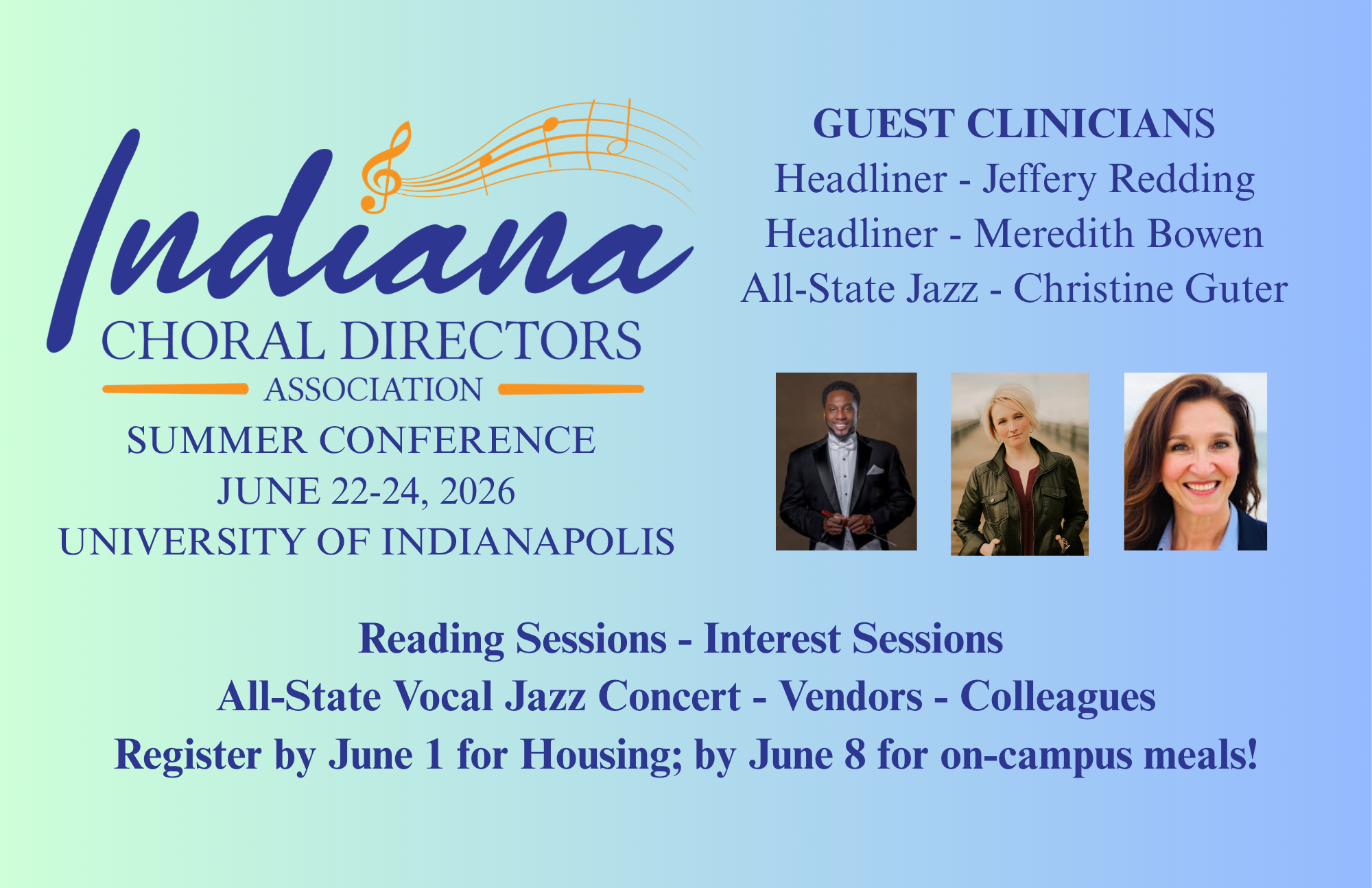
June 22-24, 2026 – University of Indianapolis

Register by Monday, June 1st for:
– Campus housing

Register by Monday, June 8th for:
– On-campus meals

Helpful Links

Conference Schedule

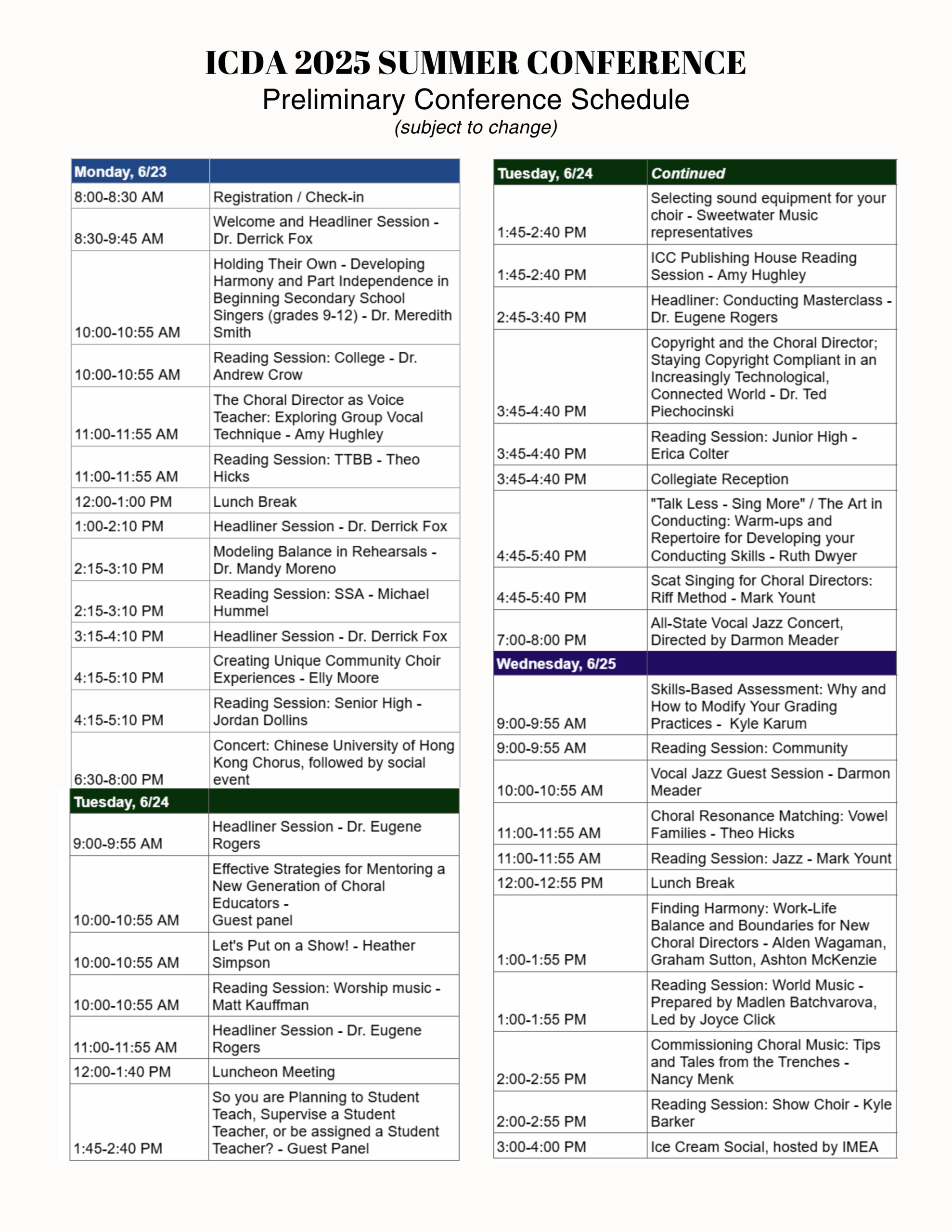
ICDA 2026 Summer Conference Schedule
Mon, June 22
Tue, June 23
Wed, June 24
Mon, June 22
8:00am
Registration/Check-In
8:00am – 8:30am
Christel DeHaan Lobby
8:30am
Expanding the Canon: Historical Choral Literature by Female Composers
Headliner Session
8:30am – 9:45am
Lilly Hall
Dr. Meredith Bowen
Read More

This interest session highlights high-quality, accessible, historical choral repertoire by female composers—music that is artistically compelling, pedagogically sound, and immediately practical for today’s ensembles. 

Participants will explore curated repertoire for treble and mixed choirs that balances musical depth with real-world considerations such as limited ranges, flexible voicing, and rehearsal efficiency. Repertoire includes works by historical composers, with strategies for integrating women composers across eras into existing concert programs. 

Attendees will leave with: 

  •  Curated repertoire lists organized by voicing and difficulty 
  • Programming and pairing strategies that support inclusive canon expansion 
  • Rehearsal and teaching insights for developing and advanced ensembles 

Designed for choral music educators seeking practical approaches to diversifying repertoire without compromising artistic standards.

Handout: Expanding the Canon

Headliner
Dr. Meredith BowenDr. Meredith Bowen
10:00am
Reading Session: Collegiate Choirs
Reading Session
10:00am – 10:55am
CDFAC – 109
Dr. Andrew Crow
Read More
Presenter
AC
Dr. Andrew Crow
Building your choir program starts with culture
A guide for establishing culture in a new position.
Interest Session
10:00am – 10:55am
CDFAC – 115
Mary Clare Davis
Read More

In these times, many schools are struggling to maintain long term performing arts teachers. Therefore, the job market for young teachers contains a large number of programs stuck in their infancy, or without a strong foundation of expectations, commitment, and standard practices to build on due to high teacher turnover or lack of funds. Additionally, only on rare occasions are first-year teachers handed a well established program, ready-made, and self-sustaining right out of college, which is often a contrast to a typical student teaching experience. 

In this presentation, I aim to give advice to younger teachers who may enter a program that needs rebuilding or rehabilitation, as well as to provide insight on how to establish yourself as a strong program leader at your new job, and make your program your own. We will discuss daily routines, student expectations, building relationships with students and building leaders and daily classroom management that will be the foundation of your classroom culture. New teachers can then build to create a large, high performing group in even some of the most challenging school environments and circumstances. This is also a great opportunity for any instrumental teachers who are teaching choir for the first time in a combination or traveling position, to learn and understand the foundational daily needs of a high functioning choir program that might be different from the standard instrumental practice.

Handout

Presenter
MCD
Mary Clare Davis
All-State Jazz Choir Rehearsal
10:00am – 12:30pm
Martin Hall – 103 & 105
11:00am
Reading Session: Treble Choir – Intermediate/Advanced
Reading Session
11:00am – 11:55am
CDFAC -109
Michael Hummel
Read More
Presenter
MH
Michael Hummel
Exploring the Intersections of Gospel Music and European Choral Traditions
Interest Session
11:00am – 11:55am
CDFAC – 115
Dr. Bryon Black II
Read More

This session will explore the dynamic intersections between gospel music and European choral traditions through the lens of three contemporary gospel composers: Isaac Cates, Diane L. White-Clayton, and Raymond Wise. Drawing from Dr. Black’s original research and interviews, this session illuminates how these composers integrate harmonic language, form, and pedagogy rooted in European classical training while remaining deeply grounded in the gospel tradition.

Choral directors will be offered pedagogical insights and repertoire recommendations that are both stylistically authentic to gospel, and accessible to ensembles trained in traditional Western art music. Participants will engage with annotated score excerpts, conductor’s analysis charts, and performance recordings to examine how gospel’s oral tradition, rhythmic drive, and expressive spirituality can harmonize with the structural clarity, counterpoint, and vocal balance of European choral works.

This session encourages reflection on our roles as conductors, educators, and ensemble communities by exploring music that crosses cultural boundaries and shares our stories through sound. By engaging both traditions, we discover deeper connections across race, history, and musical lineage, paving the way for teaching which is truly culturally responsive and engaging.

Handout

Presenter
BBI
Dr. Bryon Black II
12:00pm
Lunch Break
12:00pm – 1:00pm
Schwitzer Student Center
1:00pm
Voice Building 101: Guidelines for Choral Vocalises
Headliner Session
1:00pm – 1:55pm
RLPH
Dr. Meredith Bowen
Read More

Intentional warm-ups and vocalises are a powerful tool for building a healthy, vibrant choral sound. This interest session focuses on how to select and sequence warm-ups that efficiently develop tone, balance, flexibility, and ensemble awareness while directly supporting the demands of the repertoire.

Participants will explore practical guidelines for designing vocalises that address breath, alignment, resonance, vowel unification, and range development. The session also demonstrates how to connect warm-ups to repertoire by previewing musical and technical challenges in an accessible, low-stakes way. 

This is an active session—participants will sing and experience effective choral warm-up strategies in real time. 

Participants will leave with: 

  • Clear principles for sequencing choral vocalises 
  • Repertoire-informed warm-ups that accelerate learning 
  • Adaptable strategies for building consistent, healthy choral tone 

Designed for choral music educators seeking efficient, purposeful approaches to voice building from the first minutes of rehearsal.

Handout: Vocalises 101

Headliner
Dr. Meredith BowenDr. Meredith Bowen
1:30pm
All-State Jazz Choir Rehearsal
1:30pm – 3:30pm
Martin Hall – 103 & 105
2:00pm
Vendor Introductions
2:00pm – 2:10pm
RLPH
2:15pm
Reading Session: Tenor Bass Choir – Intermediate/Advanced
Reading Session
2:15pm – 3:10pm
CDFAC -109
Theo Hicks
Read More
Presenter
TH
Theo Hicks
Masterful Modeling: Balance in the Ensemble Setting
Interest Session
2:15pm – 3:10pm
CDFAC – 115
Mandy Moreno
Read More

As conductors, directors, and music educators, we constantly model for our students—demonstrating how to breathe, phonate, shape musical phrases, and engage as both performers and audience members. Because vocalists rely on their bodies for resonance, breath support, and expressive singing, it is essential that we guide them in proper posture and alignment, whether seated or standing. Just as importantly, we must be intentional about modeling these principles from the podium, where our own physical alignment, movement, and breath set the foundation for what we ask our students to do. This session will explore ways to consciously model alignment while conducting and teaching, addressing:

  • Maintaining effective body alignment in both seated and standing positions. The role of leg and knee positioning in overall posture and movement.
  •  Demonstrating healthy alignment and movement throughout rehearsals, ensuring our conducting gestures reinforce the physical principles we teach.
  • Breathing while conducting and its impact on ensemble sound.
  • Adjusting physical engagement for different repertoire styles—balancing energy in up-tempo or dramatic works vs. maintaining ease in calm, ballad-esque selections.
  • Holding folders, binders, and octavos in ways that support, rather than hinder, vocal production.

By understanding the anatomical foundations of efficient movement and integrating these principles into our conducting, we provide a clear, embodied model for our students. When we align our own bodies with the principles we teach—both in instruction and from the podium—we empower singers to develop healthier, more sustainable performance habits.

Presenter
MM
Mandy Moreno
3:15pm
Still I Rise: Empowering Treble Voices
Headliner Session
3:15pm – 4:10pm
RLPH
Dr. Meredith Bowen
Read More

This interest session centers on empowering treble singers through intentional choices in literature, pedagogy, and rehearsal culture. Designed for choral music educators working with treble ensembles, the session examines how repertoire selection, body awareness, and sound concepts intersect with the systems and structures that shape singers’ experiences. 

Participants will explore literature that supports healthy vocal development and expressive singing, alongside practical strategies for cultivating body awareness, breath, and resonance in rehearsal. The session also addresses the often-unexamined systems—such as voicing practices, ensemble hierarchies, rehearsal norms, and institutional expectations—that influence how treble voices are trained, valued, and heard. 

Attendees will leave with: 

  • Literature selections that empower developing and advanced treble voices
  • Rehearsal strategies that integrate body awareness and efficient, resonant sound
  • Tools for examining and reshaping structures that impact treble singers’ agency and success 

This session invites educators to reimagine treble choral work as a space where singers are supported musically, physically, and systemically—resulting in healthy voices and confident musicians.

Handout:  Still I Rise


Headliner
Dr. Meredith BowenDr. Meredith Bowen
4:00pm
All-State Jazz Choir Rehearsal
4:00pm – 5:30pm
Martin Hall – 103 & 105
4:15pm
Reading Session: Sr. High Mixed
Reading Session
4:15pm – 5:10pm
CDFAC – 109
Jordan Dollins
Read More
Presenter
JD
Jordan Dollins
Critiques & Construction: Approaches to Decolonizing Choral Curricula
Interest Session
4:15pm – 5:10pm
CDFAC – 115
Taylor Perez
Read More

This project examines the K-12 choral classroom and the “standard” repertoire and pedagogical practices, further critiquing how the persistent privileging of white, Eurocentric musical traditions shapes student learning and participation. Existing research suggests that disrupting Eurocentric curricular norms requires self– and community– reflection from music educators in order to interrupt racially exclusionary teaching cycles. Other researchers have detailed the benefits of a decolonized curricula, as well as the frameworks needed to implement that line of work. However, practical guidance for implementation in choral settings is often vague or underdeveloped.

Building on this scholarship, the central purpose of this project is to articulate not only ‘why’ decolonizing choral music is necessary and ‘who’ benefits from this process, but ‘what’ decolonization actually looks like in the choral classroom as well as the actual ‘how’ – or practicality of how to realistically engage in this anti-racist, multicultural approach to teaching choral pedagogy. This study is grounded in anti-racist and equity-based theoretical frameworks and employs music anthologies and choral curricula to analyze historically racialized repertoire, alongside curated spreadsheets that organize alternative repertoire by origin, voicing, language, historical context, and available recordings (or another contributory resource for the larger choral community to access and reference). This research is guided by the premise that regardless of the subject matter, students build their identities with the curriculums and information they are taught. By designing choral curricula that not only includes but meaningfully affirms the room’s diverse cultural identities, educators can foster deeper musical engagement, confidence, and a sense of belonging within the ensemble. Further, educators that engage in this line of pedagogies can expand their knowledge, begin creating distinctive programs, and grow their pedagogical confidence.

Presenter
TP
Taylor Perez
5:15pm
Dinner Break
5:15pm – 6:30pm
Schwitzer Student Center
6:30pm
Performance
Joyful Songsters, Castlewood Singers, Irvington
Concert
6:30pm – 8:00pm
RLPH
Tue, June 23
9:00am
Reading Session: Worship
Reading Session
9:00am – 9:55am
CDFAC -109
Matt Kauffman
Read More
Presenter
MK
Matt Kauffman
Classroom Management for the Middle School Choir Room
Interest Session
9:00am – 9:55am
CDFAC – 115
Dan Andersen
Read More

Getting your students to work hard and do what we need them to do can be tricky, especially with Middle School students! In this session you will be given some practical ideas to help you gain and maintain control in your classroom.  This ultimately will allow you to develop your choirs to their highest level of excellence.

Presenter
DA
Dan Andersen
We can read – Why do we need solfège?
The many uses of solfège to accomplish MORE than your literacy standard
Interest Session
9:00am – 9:55am
CDFAC – 108
Dr. Meredith Smith
Read More

This session will explore the benefits of utilizing moveable do in the choral classroom beyond just reading the notes on the page. Various examples will be shared that illuminate solfege as a means to work through vowel shapes, intervallic relationships, key changes, harmonic analysis, modes, composition and tonal memory during choral rehearsals. All activities are meant to tie directly and efficiently into the music repertoire you are already teaching. Attendees will leave the session with many useful activities and ideas that are ready to implement in their classrooms.

Handout

Presenter
MS
Dr. Meredith Smith
9:30am
All-State Jazz Choir Rehearsal
9:30am – 12:00pm
Martin Hall – 103 & 105
10:00am
Programming: The Art of Programming and the Human Connection
Headliner Session
10:00am – 10:55am
RLPH
Dr. Jeffery Redding
Read More

Curating the Narrative Journey

Programming is more than a sequence of titles; it is a shared journey between the singer, the score, and the listener. This session explores the intentionality behind repertoire selection as a means of storytelling. Dr. Redding discusses how to build a program that speaks to the spirit through a deliberate and visceral narrative arc.

Participants will explore:

  • The Art of Programming: Crafting a cohesive experience that mirrors the human condition—moving through tension, release, sorrow, and joy.
  • Pacing for the Singer: Managing the vocal and physical stamina of an ensemble through smart sequencing that allows for both recovery and peak intensity.
  • The Narrative Bridge: Using spoken word, silence, or movement to create a cohesive story that transforms a “concert” into a “communion.”
  • Intentional Choices: How specific musical decisions can challenge a singer’s perspective and foster an empathetic ensemble culture.
Headliner
Dr. Jeffery ReddingDr. Jeffery Redding
11:00am
The Conductor’s Code: 10 Pillars of Passion and Purpose
Headliner Session
11:00am – 11:55am
RLPH
Dr. Jeffery Redding
Read More

Establishing a Culture of Excellence and Belonging

The difference between a struggling program and a thriving one is Culture. This session outlines Dr. Redding’s “Conductor’s Code”—ten fundamental pillars designed to ground the educator and inspire the student. It is a roadmap for leading with a “People First” mentality while demanding uncompromising musical standards.

The Session will address:

  • The 10 Pillars: A deep dive into core values such as Authenticity, Stewardship, Grace, and Relentless Excellence.
  • People First, Music Second: Viewing the rehearsal as a space to inspire the human being; when the people are inspired, they make the music.
  • The Power of the Pivot: Strategies for maintaining a positive, purpose-driven environment when faced with institutional challenges or student burnout.
  • Mentorship as Legacy: How we cultivate the next generation of leaders by modeling a life of passion, not just a career in music.
  • Refueling the Fire: Practical wisdom on how to stay inspired and maintain your own “Purpose” so you can continue to pour into your students.
Headliner
Dr. Jeffery ReddingDr. Jeffery Redding
12:00pm
Luncheon Meeting
12:00pm – 1:40pm
Schwitzer Student Center – Enders
1:00pm
All-State Jazz Choir Rehearsal
1:00pm – 5:00pm
Lilly Hall
1:45pm
Reading Session: ICDA Mentorship Initiative
Tried and True Choral Literature for Beginning, Middle, and Advanced Choirs
Reading Session
1:45pm – 2:40pm
CDFAC – 109
Read More

Members of the ICDA Mentorship Initiative will lead a collaborative session highlighting effective repertoire for beginning, intermediate, and advanced choirs. Mentor conductors will present selected works and guide participants through each piece, allowing attendees to engage with the music through active singing. Presenters will also share pedagogical approaches, rehearsal strategies, and instructional techniques used to support musical development and ensemble growth across varied instructional contexts. This session is designed to serve choral educators at all stages of their professional careers, from pre-service teachers to experienced conductors, by providing practical, adaptable repertoire and teaching strategies applicable to a wide range of choral settings.

Handout

Interactive Discussion – Building a Group II, III, IV & V Solo/Ensemble Suggested Repertoire List
Interest Session
1:45pm – 2:40pm
CDFAC – 115
Bill Niederer
Read More

This session is an interactive discussion to help put together a suggested list for ISSMA Solo/Ensemble events in the group II to V level. Teachers and students often struggle to match the difficulty level of the literature to be performed with the group level. In this session, we hope to come away with a list of resources and music that can be shared with teachers and students that will work well for this event. Other topics for discussion related to building a list of suggested repertoire include practice tools, a timeline for success, and a general set of ideas for teachers to help their students find success with solo and small ensemble performances.

Handout

Presenter
BN
Bill Niederer
2:45pm
Conducting: Presence, Pulse, and Purpose
Headliner Session
2:45pm – 3:40pm
CDFAC – 115
Dr. Jeffery Redding
Read More

Leading Beyond the Pattern: An Interactive Lab

In this session, the participants become the ensemble. Through active singing and response, attendees will experience firsthand how a conductor’s presence serves as the primary catalyst for choral sound. Dr. Redding demonstrates how to move beyond the technical pattern to elicit an authentic response from the choir.

Key highlights include:

  • Authenticity on the Podium: Experiencing how a conductor’s physical transparency invites the ensemble to respond with a deeper level of engagement.
  • Pulse vs. Pattern: Shifting from rigid time-keeping to a gesture that prioritizes the “living pulse” of the music and the text.
  • Visual Communication: Using facial affect and eye contact to communicate nuance and dynamic intensity that words cannot describe.
  • Efficiency of Gesture: Eliminating “noise” in the hands to allow the choir’s natural resonance and phrasing to take center stage.
  • The Internal Intent: A live demonstration where participants feel how a shift in the conductor’s mental focus immediately changes the harmonic clarity and warmth of the room.
Headliner
Dr. Jeffery ReddingDr. Jeffery Redding
3:45pm
Reading Session: Treble & Tenor/Bass – Middle School/HS Beginning
Reading Session
3:45pm – 4:40pm
CDFAC – 109
Erica Colter, Theo Hicks
Read More
Presenters
EC
Erica Colter
TH
Theo Hicks
Panel Discussion: Show Choir
Interest Session
3:45pm – 4:40pm
CDFAC – 115
Joshua Doubblestein
Read More

Show Choir for All: A panel discussion on how to include show choir in your choral program

Panel: 

Jordan Dollins, Portage High School

Mark Myers, Lafayette Jefferson High School

Graham Sutton, Westfield High School

This panel discussion is set up to talk about the many different ways that you can incorporate show choir into your school choral program. Panel members from multiple schools will be present to discuss show choir as a meaningful part of teaching students. Although several schools in the state compete with their choirs, not every school needs to compete to have success. There are several ways to incorporate show choir as an exciting addition to your ensembles, and this discussion hopes to give and share ideas for new are experience show choir directors in the state. How to structure a program, types of concerts/shows to put together, how to manage a program, costumes/makeup/hair/shoes, working with staff, etc.

Presenter
JD
Joshua Doubblestein
4:45pm
Reading Session: Middle School Mixed
Reading Session
4:45pm – 5:40pm
CDFAC – 109
Erica Colter
Read More
Presenter
EC
Erica Colter
Preparing for the First Week of Choir, Getting Your Choir Off on the Right Note & College Networking Session
Interest Session
4:45pm – 5:40pm
CDFAC – 115
Joyce Click, Dr. Meredith Smith
Read More

Starting a choir program can feel overwhelming, especially in the first days of school. This session is designed for pre-service teachers, student teachers, and early-career choir directors who want practical, confidence-building strategies for launching a successful choral program from day one. Participants will explore effective first-week routines, rehearsal structures, classroom management techniques, and community-building strategies that establish positive musical and social expectations. Emphasis will be placed on creating an inclusive, engaging, and student-centered choral environment that sets the tone for the entire year. The discussion will be facilitated by faculty from area Universities.

Following the session, attendees are invited to a College Day Reception and Discussion, bringing together collegiates, recent graduates, and university professors. This informal reception provides an opportunity to network, share experiences, ask questions about the transition from college to the profession, and engage in meaningful dialogue with peers and mentors in choral and music education.

Handout

Presenters
JC
Joyce Click
MS
Dr. Meredith Smith
5:45pm
Dinner Break
5:45pm – 6:55pm
Schwitzer Student Center
7:00pm
All-State Jazz Choir Concert
Headliner Session
Concert
7:00pm – 7:55pm
RLPH
Christine Guter
Read More
Headliner
Christine GuterChristine Guter
8:00pm
Social Hang Out
Social Time
8:00pm – 9:30pm
BJ\’s Brewhouse – 1251 U.S. Hwy 31 N, Greenwood, IN 46142
Read More

All are welcome to attend immediately following the All-State Vocal Jazz concert.  The drive is about 15 minutes from UIndy.

Wed, June 24
9:00am
Reading Session: Community
Reading Session
9:00am – 9:55am
CDFAC -109
Angela Hampton
Read More
Presenter
AH
Angela Hampton
Middle School Choir: Bruh!
Interest Session
9:00am – 9:55am
CDFAC – 115
Stephanie Rappatta
Read More

Throughout this session, I will share what has worked for me as I have gone about teaching an urban middle school choir. I will share why I think middle school choir is an important fundamental builder for future high school programs and ideas that can be incorporated to build those skills. would like to talk about a year overview to give perspective of what can happen in an urban middle school choral classroom including but not limited to beginning of the year prep, assessments that have worked, concert prep: including solo and ensemble, middle school honor choir, circle the state with song, ISSMA organizational festival and spring concert, incorporation of building wide expectations such as reading/literature strategies in the classroom. I would like to share some repertoire that has been useful within my program as well as technology and other literature that I have found useful to help strengthen my skills and the students’ skills in my classroom. I also want to provide opportunities for others to share what has worked for them. My hope is that when an attendee leaves this session that they walk away with ideas to help embolden them in a middle school choral classroom or to help them want to teach in a middle school choral classroom.

Handout

Presenter
SR
Stephanie Rappatta
10:00am
The Vocal Jazz Director’s Playbook: Repertoire, Groove, and Musical Integrity
Headliner Session
10:00am – 10:55am
CDFAC – 115
Christine Guter
Read More
Directing a vocal jazz ensemble that is impactful, educational, and meaningful to both performers and audience members is so much more than just “the show.” It’s about cultivating a sound, a style, and an artistic vision that inspires.
This session offers directors practical tools for building a successful ensemble, from selecting repertoire, to teaching authentic swing and groove, to fostering musical integrity in rehearsal and performance. Participants will leave with strategies to balance technical precision with expressive artistry, empowering singers to connect deeply with the music while keeping the joy, energy, and creativity of vocal jazz at the center.
Headliner
Christine GuterChristine Guter
11:00am
Reading Session: Vocal Jazz
Reading Session
11:00am – 11:55am
CDFAC -109
Kyle Broady, Mark Yount
Read More
Presenters
KB
Kyle Broady
MY
Mark Yount
Sing with Color
Interest Session
11:00am – 11:55am
CDFAC – 115
Kerry Glann
Read More

How do we enrich the sound of our choirs?  How do we help our choirs sing with consistency and a maturity of tone appropriate for their level of development? How do we address pesky “problem spots” in our choral sound that may impact elements like blend, balance, and tuning? Explore techniques for achieving a rich, colorful, vibrant choral tone through concepts of timbre matching and vowel modification. The clinician will share techniques from his perspective on developing choral sound and lead attendees through exercises and excerpts to bring these ideas to life.

Presenter
KG
Kerry Glann
12:00pm
Lunch Break
12:00pm – 12:55pm
Schwitzer Student Center
1:00pm
Reading Session: World Music
Reading Session
1:00pm – 1:55am
CDFAC – 109
Madlen Batchvarova, Joyce Click, Emma Mundy
Read More
Presenters
MB
Madlen Batchvarova
JC
Joyce Click
EM
Emma Mundy
Reading Session: ICC Publishing House
Reading Session
1:00pm – 1:55pm
CDFAC – 108
Jordan Dollins
Read More
Presenter
JD
Jordan Dollins
Expanding the Conductor’s Palate: Exploring the Laban “Efforts” as a Tool for More Expressive Gestural Communication
Interest Session
1:00pm – 1:55pm
CDFAC – 115
Chris Albanese
Read More

Rudolf von Laban was an early 20th century Austro-Hungarian dancer, choreographer, and  teacher noted for his pioneering work in the medium of modern dance. As a theorist, he qualified physical movement within four categories: flow (free vs. bound), weight (light vs. heavy), time (sustained vs. quick), and space (indirect vs. direct). When performed in combination, these Laban “”efforts”” can be described using a series of action verbs: float, wring, glide, press, flick, slash, dab, and punch. 

This session explores the Laban “”actions”” as a tool through which conductors can develop a more varied and expressive gestural palate, and conducting teachers can develop straightforward language with their students around the quality of movement and its relationship to sound. Participants will create their own Laban chart, relating each action to a phonetic rehearsal syllable (“”oo””= float, “”errr””=wring, etc.) and an excerpt from the choral repertoire (slash= opening of “”Dies Irae, Verdi Requiem, etc.). The session will conclude with a game of Laban charades in which participants will demonstrate the actions within the context of a simple musical excerpt.

2:00pm
Reading Session: Show Choir
Reading Session
2:00pm – 2:55pm
CDFAC -109
Joshua Doubblestein
Read More
Presenter
JD
Joshua Doubblestein
Your Voice Is Your Curriculum: Vocal Health Strategies for Choir Directors
2:00pm – 2:55pm
CDFAC – 115
Theo Hicks
Read More

“Music educators rely on their voices as their primary teaching instrument, yet few receive practical training in sustaining healthy, efficient voice use across the demands of a full school day. This session explores vocal health through the lens of applied pedagogy, equipping choir directors and music teachers with resonance-based strategies that support both longevity and effectiveness in the classroom. Drawing from principles of vocal pedagogy and acoustic efficiency, participants will examine how speaking and singing habits influence fatigue, clarity of instruction, and overall classroom presence.

Rather than presenting vocal health as a set of isolated exercises, this session emphasizes sustainable teaching practices. Topics include resonant speaking versus pressed phonation, managing vocal load across rehearsals and academic classes, and using semi-occluded vocal tract (SOVT) strategies as brief “resets” between teaching blocks. Attendees will also explore rehearsal techniques that reduce unnecessary vocal strain, such as strategic modeling, gesture-based instruction, and ensemble-led demonstrations.

Through practical examples and guided reflection, educators will learn to recognize early signs of vocal fatigue, adjust rehearsal pacing to protect their voices, and model healthy vocal behaviors for students. The goal is not to speak less, but to speak and sing more efficiently—aligning vocal pedagogy with the realities of daily teaching. Participants will leave with adaptable tools, rehearsal-ready language, and a clearer framework for treating their own voices as an essential and sustainable part of their educational practice.”

Presenter
TH
Theo Hicks
3:00pm
Ice Cream Social
Social Time
3:00pm – 4:00pm
CDFAC – Lobby
IMEA
Read More
Presenter
I
IMEA

Partners & Vendors

Headliners

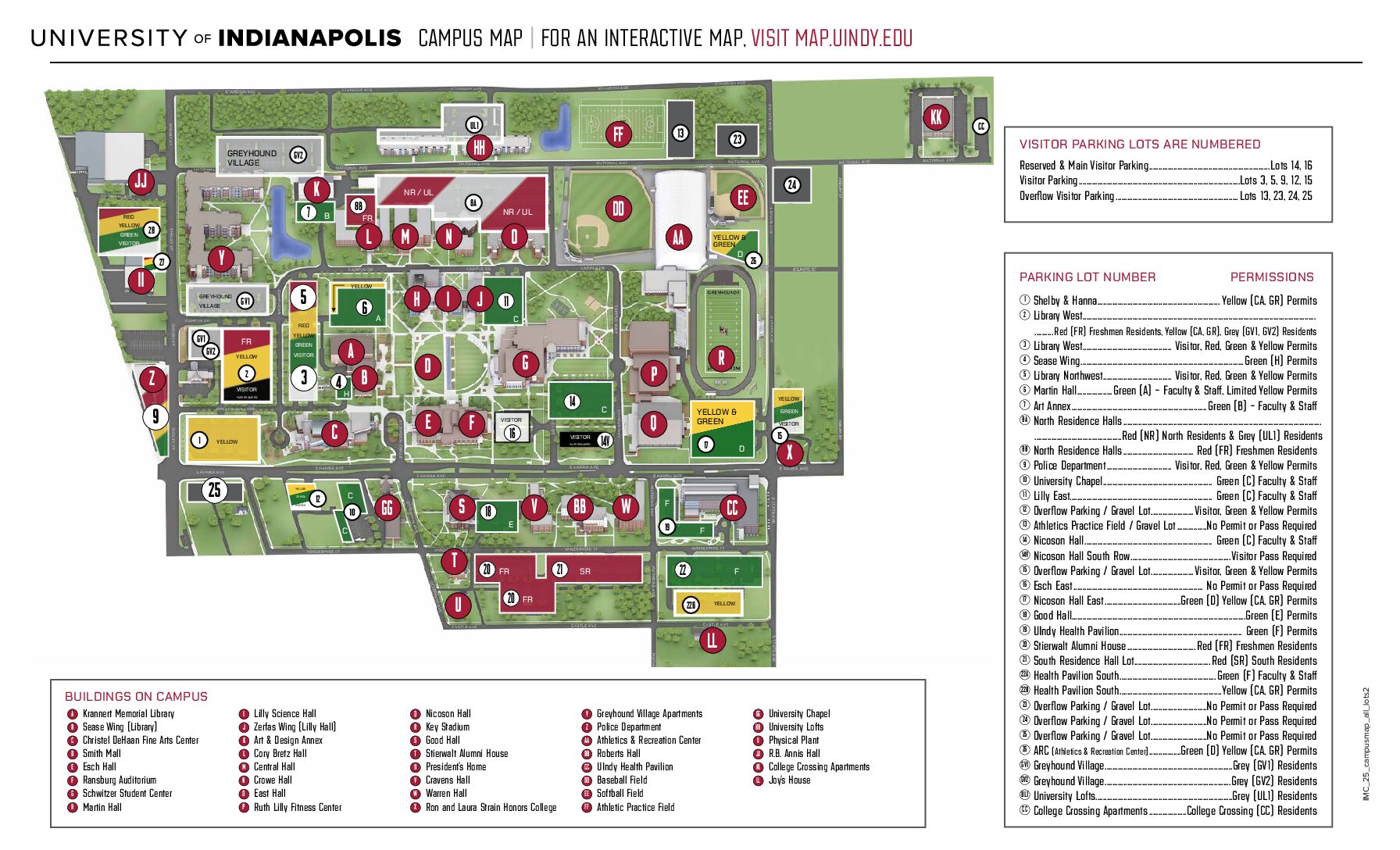
Campus Map

University of Indianapolis

Buildings for ICDA Conference

Christel DeHaan Fine Arts Center – All conference sessions and concerts

Martin Hall – All-State Vocal Jazz rehearsals

Schwitzer Student Center – On-campus meals & ICDA Luncheon

Corey Bretz Hall – On-campus housing

Parking – Lot 1, 2, or 3 (restrictions not enforced in the summer)

Connect to WIFI

WIFI Network Name: UIndy

Follow the prompts after connecting to the WIFI network.

Dining Options

On-campus meals will be served in the Ober Dining Hall located within Schwitzer Student Center for those who selected lunch/dinner options during registration.

Ober Dining Hall hours:
M-F 8am-10am, 11am-2pm, 5pm-7pm
Sat-Sun 11am-2pm, 5pm-7pm

Hound Express is inside Schwitzer Student Center and features grab & go items, cold & frozen foods, candy, snacks, and beverages. Summer Hours are M-F 9am-5pm.